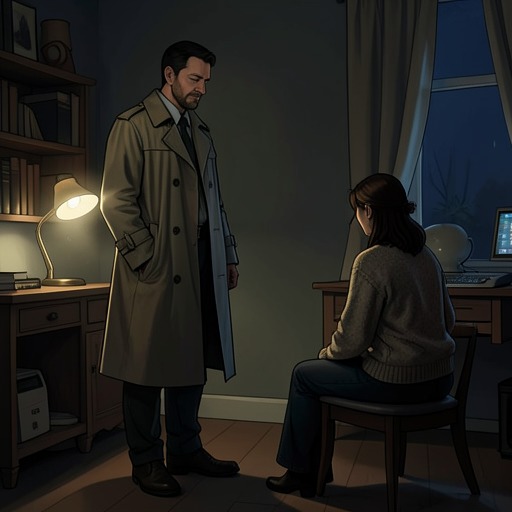
John Rebus and Tracy’s protection and investigation relationship
Hide and SeekJohn Rebus and Tracy’s protection and investigation relationship is an uneasy bond in which refuge and suspicion coexist. Rebus offers Tracy shelter and tries to keep her safe, yet he also investigates her possible role in the events surrounding Ronnie McGrath. His care is real but compromised by professional pressure, untested assumptions, and his tendency to decide what is best for her; Tracy accepts help when it suits her, resists his authority, and finally breaks away.
Shelter and Uneasy Dependence
Tracy’s connection with Rebus first takes shape through the shelter she finds at his flat. The room retains evidence of her recent presence: she had brought him breakfast, and the dishes remain beside his unmade bed. Her laughter at his mattress on the floor had briefly made the place feel shared. Once she is gone, Rebus experiences the flat as newly empty and less secure than before. The domestic details register a closeness that neither of them has formally defined, and its abrupt absence unsettles him.
The arrangement also carries an imbalance. Tracy has received a bed, wine, a bath, and breakfast, while Rebus has assumed the role of host and protector without knowing much about her. He later wonders whether she had used his hospitality, but that suspicion does not erase his concern. He checks with the station about her condition and learns that she is irritable, refusing food, and complaining of pain. He considers withdrawal more likely than appendicitis, feels guilty for not visiting sooner, and nevertheless postpones the visit until morning. His decision shows both his sense of responsibility and his fatigue with what he sees as the sordid work of intervening in other people’s lives.
Protection Becomes Investigation
When Rebus takes Tracy out of the station, she is silent and sullen, watching the shops, shoppers, tourists, and children from the car. He has held the door open to dissuade her from simply walking away, then explains that keeping her there had been for her safety while he made inquiries. His explanation assumes that protection gives him a measure of authority over her. Her quiet displeasure makes clear that she does not experience the arrangement as uncomplicated care.
That conflict sharpens when Rebus confronts her with a theory about Ronnie’s photographs. He suspects that she modelled for a photographer, brought him Ronnie’s pictures, and may have done so for money or to spite Ronnie. Rebus presents the theory forcefully, but the account remains his conjecture, not a confirmed explanation. Tracy breaks down as he presses her, and he later recognizes that she has not confessed to the act he suspects. He had left her overnight in the cells to see whether she would crack; when she did not, he supposed she might be innocent of the central suspicion, while continuing to wonder whether she had a drug habit. His investigative method thus strains the trust created by his earlier hospitality: he offers a haven, then tests her as a suspect.
The photographs give this distrust a material focus. At Ronnie’s squat, Rebus had seen a portfolio pinned to a bedroom wall, including images of Edinburgh Castle and a posing girl. Later, Nell Stapleton identifies the woman who attacked her at the University of Edinburgh library as the girl in a nude photograph Brian Holmes had carried in his briefcase. Rebus’s suspicion that Tracy took Ronnie’s pictures to the photographer draws on a wider trail of images and possible exchanges, but the evidence available to him does not establish that she did so. The pictures connect Tracy to the investigation while also showing how readily her image becomes something other people interpret, circulate, or use as evidence.
A Reversal in the Car
During the drive, Rebus tells Tracy he had kept her out of danger while checking on matters connected with her. He then reveals that he intends to question the photographer about her modelling and the pictures. The conversation moves from an asserted effort to protect her into a direct accusation, and Rebus’s certainty leaves little room for her account. Tracy first tries to get out of the car; when she succeeds in breaking away, she leaves Rebus behind and runs. The sudden reversal makes plain that she is not simply a dependent person under his protection: she can reject the relationship on her own terms, even at the cost of abandoning the refuge he provided.
Afterward, Rebus tells himself he is not worried about her because she can look after herself. Yet his account is unsettled by his admission that he still knows very little about her, and by his questions about why she came to him and whether anyone had really been following her. He considers that she may have secured a bed, wine, a bath, and breakfast through her own resourcefulness. His uncertainty does not resolve into a firm judgment about her motives. Instead, it exposes the limits of his protective role: he has mistaken access to her immediate needs for knowledge of her circumstances.
The Relationship After the Break
Tracy’s later assault on Nell at the library brings her back into Rebus’s investigative orbit. Nell writes that the woman tried to force her way past the guard and struck her after Nell attempted to intervene. She recognizes Tracy from the photograph and asks where Holmes is, connecting the incident to the continuing pursuit of pictures and information. Rebus reads Nell’s account as another link in the trail left by Tracy, but still considers whether Tracy has acted impulsively or for a reason. His concern and his police suspicion remain intertwined rather than resolving into a straightforward rescuer-and-victim relationship.
The final outcome is distance, not reconciliation between Rebus and Tracy. Rebus is pleased when Tracy finds work in a cafe near the University of Edinburgh library through Nell. Later, he sees Tracy sharing a meal and a joke with Holmes and Nell, and leaves without ordering. The scene shows her participating in a social life beyond his protection, while Rebus remains outside it. Their relationship has enabled temporary safety and produced important investigative confrontations, but it has not given Rebus lasting authority over Tracy or a clear understanding of her. Its defining tension is the gap between caring for someone and believing that care entitles the protector to control, test, or explain her.